Sanjit “Bunker” Roy passed away on November 10, 2026, at the age of 81, but he will live on in our hearts.
Throughout his life, Bunker Roy gave altruism a deeply concrete form by helping communities find, within their own wisdom and the knowledge they could acquire, the means to act on their own for the good of their communities.
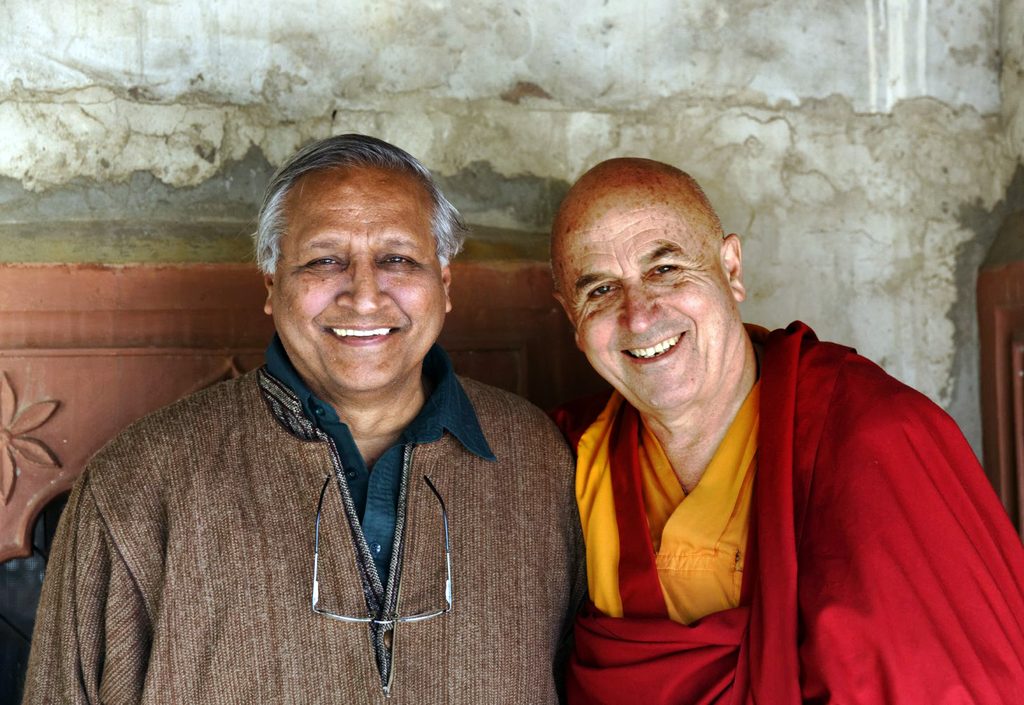
Bunker Roy, with whom I shared a deep bond of friendship and complicity, used to say that at the age of twenty, as the son of a well-to-do family educated at one of India’s prestigious colleges, he was destined for a brilliant career. His mother already envisioned him as an engineer or a World Bank official. That year, in 1965, a terrible famine broke out in the province of Bihar, one of the poorest in India. Bunker, inspired by Jai Prakash Narayan—a friend of Gandhi’s and a great Indian moral leader—decided to go with friends his own age to see firsthand what was happening in the hardest-hit villages. He returned a few weeks later, a changed man, and told his mother he wanted to go live in a village. After a moment of dismayed silence, his mother asked him, “And what are you going to do in a village?” Bunker replied, “Work as an unskilled laborer digging wells.”
“My mother nearly fell into a coma,” Bunker recounts. The other family members tried to reassure her, saying, “Don’t worry—like all teenagers, he’s going through a phase of idealism. After toiling there for a few weeks, he’ll come back.”
But Bunker didn’t come back and stayed in the villages for forty years. For six years, he dug three hundred wells with a jackhammer in the countryside of Rajasthan. His mother didn’t speak to him for years. When he settled in the village of Tilonia, the local authorities didn’t understand either:
– Are you running away from the police?
– No.
– Did you fail your exams? Or did you fail to get a government job?
– No, not that either.
Someone from his social background and with such a high level of education didn’t belong in a poor village.
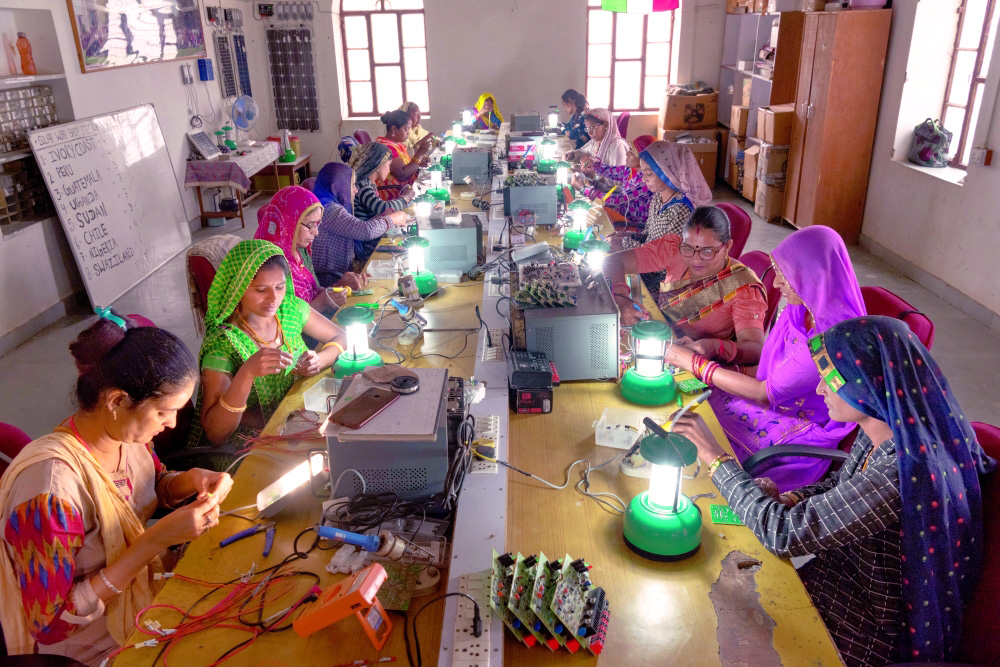
Bunker realized he could do more than just dig wells. He observed that men who had received an education were leaving for the cities and no longer contributed in any way to helping their villages. “Men are unusable,” he proclaimed mischievously. “As soon as they get a degree, they head for the cities. ” It was therefore better to educate women, particularly young grandmothers (ages 35–50), who had more time on their hands than mothers with young children. Even if they were illiterate, it was possible to train them to become “solar engineers,” skilled in the manufacture of photovoltaic panels. Moreover, there was little risk that they would leave their village.
Bunker was long ignored and then criticized by local authorities and international organizations, including the World Bank. But he persevered and trained hundreds of illiterate grandmothers who provided solar power to nearly a thousand villages in India and many other countries. His work is now supported by the Indian government and held up as a model around the world. He has also designed programs aimed at harnessing farmers’ ancestral know-how, particularly methods for collecting rainwater to fill cisterns large enough to meet the villagers’ annual needs. Previously, women had to endure several hours of walking each day to carry back heavy jugs of water that was often contaminated. In Rajasthan, he founded the Barefoot College, where no one with a degree is allowed, but where people share their experience based on years of practical work. Everyone there lives simply, in the style of Gandhi’s communities, and no one is paid more than 100 euros a month.
Of course his family is now very proud of him. Thus, for many years, what seemed to his loved ones to be a senseless sacrifice was, for him, an achievement that filled him with enthusiasm and contentment. Far from discouraging him, the difficulties he encountered along the way only served to stimulate his intelligence, compassion, and creative abilities. Bunker ultimately carried out a multitude of remarkable projects in 27 countries. What’s more, his whole being radiated the contentment of a life well-lived.
To teach the villagers in a lively way, Bunker and his colleagues put on performances featuring large papier-mâché puppets. As a nod to those who looked down on him, these puppets are made from recycled World Bank reports. Bunker quotes Gandhi: “First they ignore you, then they laugh at you, then they fight you, then you win.”
The Shepherds’ School and the Children’s Parliament
Near Tilonia, Bunker Roy has opened 110 evening schools for farmers’ children—often girls who tend the herds during the day. A single teacher instructs students across five grade levels in a room lent by the village. These schools have given rise to a “Children’s Parliament” of forty members, the majority of whom are girls. It meets year-round, elects ministers, and convenes monthly to discuss children’s lives, unafraid to speak out against abuses. Parents and village leaders send a delegation to observe its proceedings in silence. Through election campaigns held every two years, the children learn about democracy and become equal members of society, regardless of their caste, gender, or background. They inspect schools, urge local authorities to install solar power or water pumps, and organize celebrations that bring some relief to their hard daily lives. Health authorities have also noted improved health in the villages involved. When this Parliament received an award in Sweden, the Queen asked the 13-year-old girl who served as its Prime Minister where she got such confidence. She simply replied, “I am the Prime Minister, Your Majesty.”
Karuna-Shechen has collaborated for several years with the Barefoot College on solar electrification and rainwater harvesting projects in villages in Bihar, India, as well as in Nepal. Bunker also participated in one of Karuna-Shechen’s general meetings of stakeholders, held in Nepal in 2014.
Bunker will always remain a profound source of inspiration for all who knew him.